
SoCal South Swell Season: A Month-by-Month Guide to Summer's Best Surf
Ask a Southern California surfer where the best summer swells come from and the honest answer is: about 5,000 miles away, off the coast of Antarctica. While the North Pacific goes quiet in July and August, the Southern Hemisphere is deep in its winter, and the storms spinning through the Roaring Forties are firing long-period energy straight up the Pacific toward San Diego, Orange County, and the South Bay. This is south swell season — the engine behind nearly every good summer session in SoCal.
This guide breaks down the meteorology behind those swells, why direction matters more here than almost anywhere in California, how the season unfolds month by month, and which spots switch on when the south fills in. Throughout, we lean on what our nearshore SWAN model resolves at 50-meter scale — the refraction, shadowing, and canyon focusing that a single offshore buoy simply can't see.
Where south swell actually comes from
When it's summer in California, it's winter in the Southern Hemisphere — and the Southern Ocean between New Zealand, Australia's Tasman Sea, and Antarctica becomes one of the most productive storm factories on Earth. There's almost no land down there to slow the wind, so low-pressure systems can spin up enormous, sustained fetches: hundreds of miles of gale-force wind blowing over open water for days at a time. That combination of wind speed, fetch length, and duration is exactly what builds true groundswell.
The energy that leaves those storms travels north as long-period swell, and the longer the period, the more efficiently it crosses an ocean. A 19-second swell loses very little on the trip; by the time it reaches SoCal after four or five days at sea, the short-period chop has fallen away and what's left is clean, well-spaced, powerful lines. That's why south swells so often arrive as organized corduroy rather than the messy wind swell you get from a local blow. Period is the tell: anything in the 16-to-22-second range on a southerly direction is almost certainly Southern Hemisphere groundswell that has come a very long way to reach you.
Late in the season a second source joins in. Eastern Pacific hurricane season ramps up off mainland Mexico from roughly July into October, and those tropical systems throw shorter-fetch but closer, more south-to-southeast swell at SoCal. When a Southern Hemi groundswell and a tropical pulse overlap, you get the combo days that make August and September legendary.
The swell window: why direction is everything in SoCal
Here's what makes Southern California uniquely picky: it does not have a clean shot at the open ocean. Point Conception juts out to the north, and the Channel Islands sit offshore like a breakwater, casting a swell shadow across a big chunk of the coast. Baja and the Mexican mainland block the deep south. What actually reaches the beaches is filtered through a narrow "swell window" — a band of directions, roughly 180° to 220° (due south through southwest), that can thread the gaps.
That's why two swells of identical size can produce completely different surf depending on a few degrees of direction. A due-south (180°) tropical swell lights up spots that a southwest (210°) Southern Hemi swell walls off, and vice versa. Long-period energy helps here too: an 18-second swell bends — refracts — around obstacles and wraps into coves and points that a 12-second swell rolls right past. The direction number on the forecast isn't a detail. In SoCal it's the whole story of who scores and who watches.
This is also where nearshore modeling earns its keep. Predicting a swell's open-ocean height is the easy part. Predicting how that swell refracts around the islands, funnels through the window, and reshapes over each spot's specific bottom contour is the hard part — and it's the part that decides whether your beach is three feet or six.
Month by month: how SoCal's south season unfolds
April–May — the openers. The first meaningful Southern Hemi pulses arrive, usually southwest and long-period. Sizes are moderate and inconsistent, the water is still cool, and the crowds haven't fully woken up. These early swells are a great time to relearn which of your spots respond to a clean SW angle.
June — the rhythm sets in. South swells become more frequent and reliable, often overlapping so the surf rarely goes fully quiet. Morning fog and light winds make for glassy dawn patrols before the afternoon sea breeze fills in.
July — peak consistency. This is the metronome month. Overlapping SSW groundswells in the 16-to-19-second range keep the south-facing beaches and points ticking over almost continuously. It's not always the biggest surf of the year, but it's the most dependable.
August — size and combo potential. Southern Hemi storms are still cranking, and now the Eastern Pacific tropics are online. When a groundswell stacks with a tropical south, the better south-facing spots can jump well overhead.
September — the classic. Ask a lot of locals for their favorite month and they'll say September: the warmest water of the year, the cleanest mornings, the best odds of a stacked south-plus-tropical event, and thinning crowds once school is back. If you get one memorable summer swell, it often lands here.
October — the handoff. The south season winds down but isn't done; late Southern Hemi pulses can still deliver, even as the North Pacific starts waking up and the first NW groundswells sneak in. It's the crossover month, and worth watching both windows.
Where south swell lights up
South swell rewards spots that either face directly into the window or bend the energy with a well-placed point, jetty, or reef. A few SoCal standouts:
- Lower Trestles (San Clemente) — the summer benchmark. Its cobblestone point sits open to the SW window and organizes long-period south energy into playful, high-performance peaks. When the south is on, Trestles is usually the first place to check.
- Malibu — First Point — a long, tapering right point that comes alive on a true SSW. The longer the period, the further the wall wraps down the cobblestones.
- Huntington Beach — an open beach break that loves a straight S to SSW push, with the pier refracting swell into shifting peaks on either side.
- Newport / The Wedge — the jetty refraction here supercharges a south swell into some of the most dramatic waves on the coast. It's also genuinely dangerous — a bodysurfing and experts-only zone on size, not a spot to learn on.
- North County San Diego reefs and beaches — from Cardiff to the La Jolla area, south-facing setups and offshore canyon bathymetry focus long-period energy in ways short-period swell never triggers.
The through-line: the more southerly and long-period the swell, the more these spots separate from the rest of the coast. Match the swell's direction to a spot that opens onto it and you've solved most of the puzzle.
What our SWAN model sees this season
Here's a live look at exactly this dynamic. As this went out, our nearshore SWAN model had a classic Southern Hemi south swell filling into SoCal — primary period near 16 seconds out of 193°–201°, textbook SSW. Below is the model's swell map for the California coast:
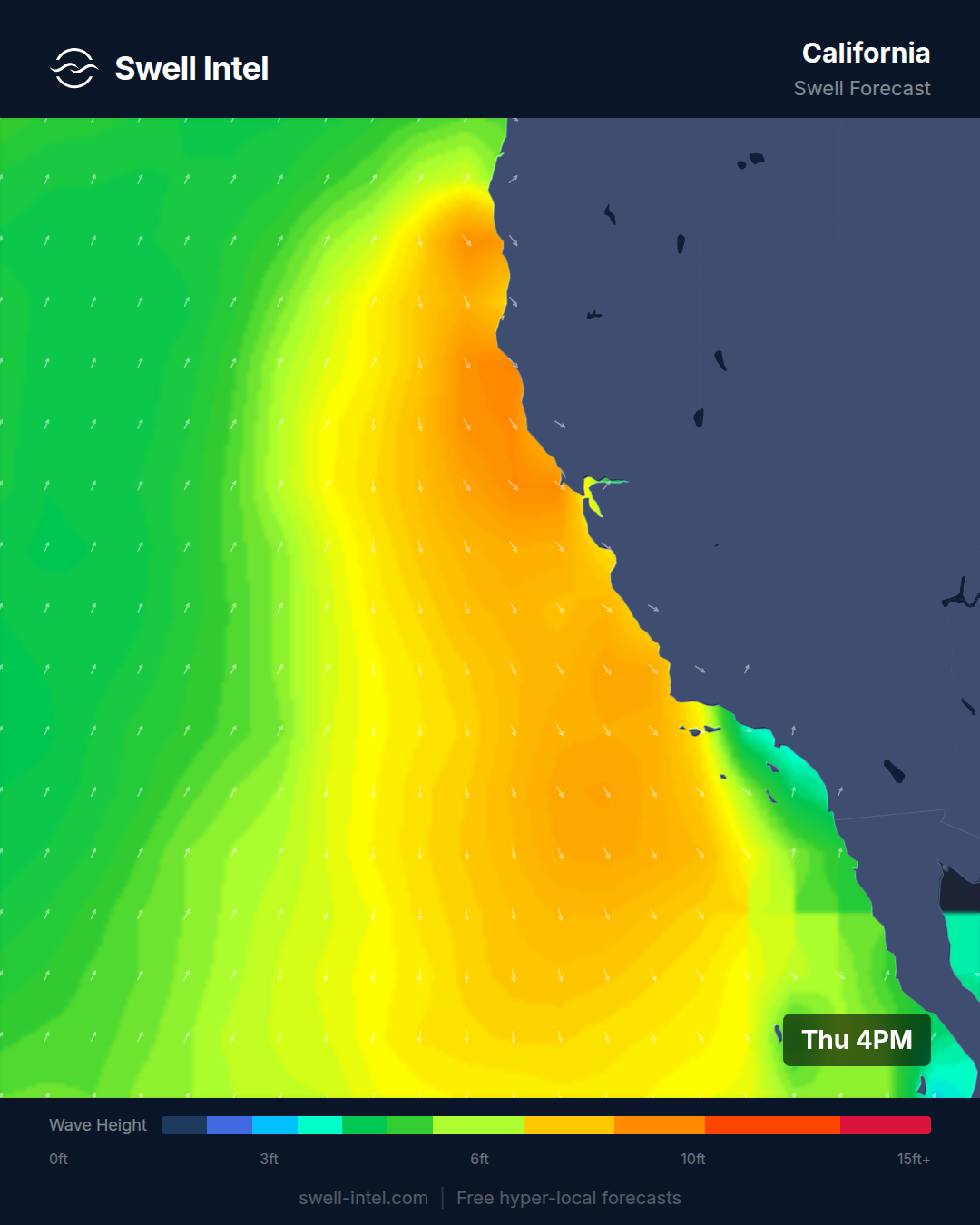
What's telling is how differently that single swell lands spot to spot. On the same 16-second SSW, the model put Trestles around 6 feet and rated it the standout, with Huntington and Malibu's First Point in the 5-foot range on nearly identical direction — while spots angled slightly off the window sat noticeably smaller on the very same energy. That spread isn't noise; it's refraction and exposure, and it's precisely what a 50-meter nearshore grid resolves that an offshore buoy reporting one open-ocean number cannot.
A buoy tells you a swell exists. Our model tells you what it becomes once it bends around the Channel Islands, funnels through the window, and stands up over each spot's bottom — the difference between "there's a south running" and "go to this spot, on this tide, tomorrow morning." Over a full south season, that's the difference between chasing swells and scoring them.
Track it live in Swell Intel
South swell season is a moving target — direction shifts a few degrees and the whole coast reshuffles. Swell Intel's nearshore SWAN forecasts give you the period, direction, and modeled face height spot by spot, so you can read exactly where the south is going to land. Track this season's south swells live in Swell Intel →